





التنقل السريع بين المنتجات
احصل على عرض سعر
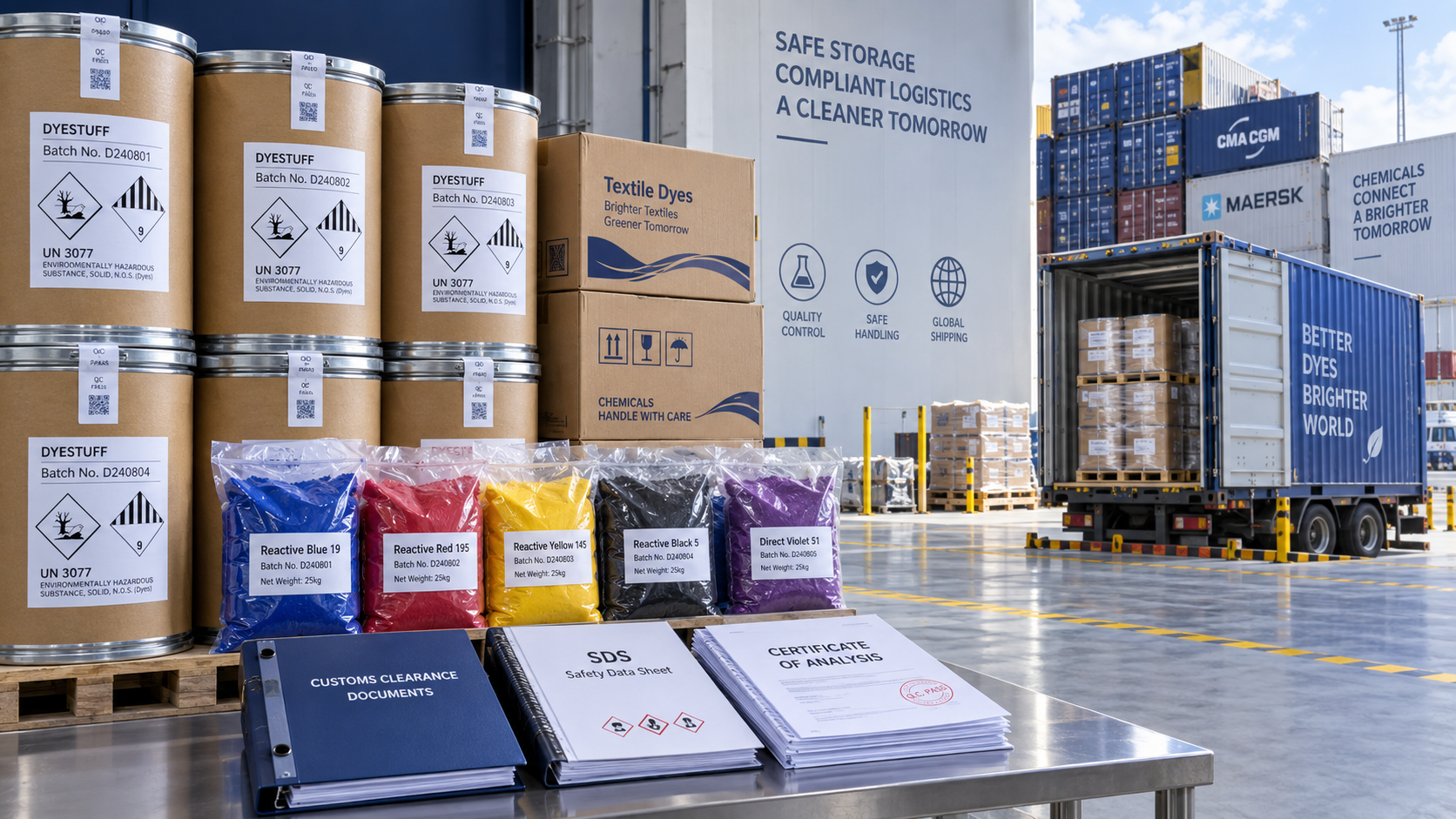
Textile dye import clearance usually requires a coordinated set of commercial, transport, safety, and product-compliance documents. The exact file set changes with the dye chemistry, shipment mode, destination rules, and intended use, but the records must describe the same goods in consistent terms. A shipment described as “textile dye” on an invoice, “pigment preparation” on a safety document, and “chemical powder” on a packing list is likely to draw questions even when the goods themselves are lawful.
The most effective approach is to treat the documentation as one product identity file rather than a collection of separate forms. Product name, Colour Index designation where applicable, chemical composition, tariff classification, batch reference, net weight, package count, and hazardous-goods status should align across the relevant records. Small discrepancies often cause more clearance trouble than a missing nonessential attachment because they make it difficult to establish what is actually being imported.
Documents normally requested at clearance
A commercial invoice is the central customs document. It should identify the seller and consignee, describe each dye product precisely, state the quantity and unit of measure, show unit and total value, specify currency and agreed trade terms, and identify the country of origin where required. Generic phrases such as “textile chemicals” are weak descriptions for a dye shipment. A clearer description distinguishes the product type, physical form, and intended textile application, such as reactive dye powder for cellulosic fibre, disperse dye granules for polyester, or acid dye for polyamide and wool.
The invoice description must reflect the product actually supplied. A trade name alone may be insufficient if it does not reveal whether the material is a dye, pigment, auxiliary, formulation, or mixed preparation. Conversely, adding an unverified chemical name simply to make the description appear more detailed can create conflict with the Safety Data Sheet. The wording should be commercially accurate and technically supportable.
A packing list connects the invoice to the physical cargo. It records package type, number of bags, drums, cartons, fibreboard boxes, intermediate containers, pallets, gross weight, net weight, and dimensions where relevant. Customs inspection and terminal handling rely on it to locate a particular item or batch. For textile dyes packed in several sizes, the list should separate the package configuration instead of stating only a combined weight. For example, ten 25 kg fibre drums and four 5 kg cartons should not appear merely as 270 kg of dye.
The transport document is normally a bill of lading for ocean freight, an air waybill for air freight, or a road or rail consignment document for other routes. Names, ports, package counts, and cargo description should be compatible with the commercial file. A transport document does not need to repeat every technical detail found elsewhere, but its broad description must not contradict the declared shipment.
A certificate of origin may be needed to support origin declaration, preferential tariff treatment, trade-control requirements, or destination-specific customs procedures. Origin is not automatically the same as shipping location. A dye dispatched from one country after storage or consolidation may still originate elsewhere. The origin statement should follow the applicable rules for the shipment rather than assume that export country and origin country are identical.
Safety papers need more than a standard SDS
A current Safety Data Sheet (SDS) is often essential for textile dyes, especially where the cargo is classified for transport, contains hazardous constituents, or is subject to local chemical notification or workplace-hazard rules. The SDS should correspond to the specific product grade and physical form. A document for a liquid version of a dye is not an adequate substitute for the powder grade because dust exposure, flash properties, packaging, transport classification, and first-aid information may differ.
For import purposes, the most closely examined SDS fields often include product identification, composition or ingredient disclosure, hazard classification, transport details, emergency contact information, and revision date. The document should identify the legal or responsible entity required by the destination market when local rules require this. An SDS prepared only for the country of export may be incomplete for the import location, even when its technical hazard data are sound.
Language is another frequent source of delay. A product safety document may be accepted in one widely used language at the point of shipment but require translation, local terminology, or locally prescribed content before release or onward sale. This issue should be resolved before arrival, particularly where the dye will enter a warehouse that must maintain compliant hazard communication records.
Textile dyes can be non-dangerous for transport while still requiring hazard communication for handling, or they can be regulated dangerous goods because of a component, solvent, oxidizing property, corrosivity, environmental hazard, or other classification. “Not regulated for transport” should therefore not be read as “no safety documentation required.” It only addresses the transport classification under the applicable mode.
Product evidence: CoA, specification, and batch traceability
A Certificate of Analysis (CoA) is not universally a customs document, yet it is often important when authorities, laboratories, end-use controls, or contract terms require proof that the imported dye matches its declared specification. The CoA should identify the product, manufacturing batch or lot, test date where shown, and measured results against stated limits or target values. It is most useful when it is tied to the exact batch numbers printed on labels and recorded in shipping paperwork.
For dyes, a CoA may include shade strength, colour shade, moisture, insoluble matter, salt content, pH, dispersibility, filtration behaviour, particle size, or other grade-specific characteristics. These values are not interchangeable across dye classes. A reactive dye commonly has different release parameters from a disperse dye, and a liquid dye formulation may require density or viscosity information that does not apply to a powder. The appropriate analysis depends on the product specification, not on a generic chemical template.
A technical data sheet or product specification is useful when the invoice description cannot communicate essential product attributes. It may clarify fibre suitability, recommended application method, solubility or dispersion requirements, storage conditions, concentration, and relevant processing limitations. It should not conflict with the CoA. The specification states what the product is intended to meet; the CoA reports results for a particular batch.
Transport classification changes the document package
Where a textile dye is regulated as dangerous goods, the shipment requires transport documentation appropriate to the mode and classification. This may include a dangerous goods declaration, container or vehicle packing certificate where applicable, and package marks and labels that match the declared information. The transport document must use the correct shipping name, identification number where assigned, hazard class, packing group where applicable, and package quantity details.
Dangerous-goods declarations should be prepared from a verified classification, not copied from a previous shipment without review. Classification can change when a formulation changes, when the concentration of a hazardous ingredient changes, or when the physical form differs. A supplier’s internal product code does not establish a transport classification. The SDS transport section, technical classification assessment, and freight booking data need to agree.
Marine transport can add a further distinction for substances classified as marine pollutants. Air transport may impose package limitations or restrictions that do not apply to ocean freight. A shipment split between air and sea should not automatically reuse the same transport paperwork. Commercial documents may remain largely consistent, while mode-specific dangerous-goods information must follow the rules for the actual carriage.
Regulatory declarations depend on dye chemistry and intended use
Some destinations require pre-import registration, notification, inventory confirmation, substance declaration, or authorization for certain chemical substances. Such requirements can apply to the dye itself, a constituent of a dye preparation, or a restricted impurity. Whether the imported material is a substance, a mixture, or an article-related chemical component matters because the applicable process may differ.
A request for “compliance documents” should be made specific before shipment. It may refer to a restricted-substances declaration, a negative statement concerning a regulated ingredient, a laboratory report, a chemical inventory status statement, or an import permit. These are different documents serving different purposes. A broad letter stating that a dye is “compliant with all regulations” is rarely persuasive because it does not identify the regulation, product, batch scope, test basis, or jurisdiction.
Textile application can affect the evidence requested after customs release as well. Dyes intended for apparel, home textiles, leather, paper, or industrial materials may be assessed against different downstream requirements. That does not mean every shipment needs every possible test report. It means the declared intended use and the available product data should not contradict each other. A dye identified as suitable for textile printing should not be supported only by a document describing an unrelated coating formulation.
Classification and description should be settled before dispatch
Tariff classification is often treated as a clerical step, but it influences duty, trade statistics, documentary review, and whether additional controls apply. Textile dyes are not all classified in the same way. Classification may turn on chemical structure, dye class, formulation, whether the material is a pigment preparation rather than a soluble dye, and whether it is put up in a particular form. The Colour Index name is technically useful, but it does not by itself determine the customs code.
Product names create a related problem. Terms such as “disperse blue,” “black dye,” or “textile colorant” may identify a commercial family without identifying a precise imported product. A stronger document set combines the commercial name with the technical dye class, physical form, product code, and any relevant chemical identifier. The level of disclosure should be sufficient for customs and safety assessment while respecting legitimate confidential formulation information under the rules that apply.
Labels should reinforce, rather than replace, the paper trail. Outer packages should show the product identifier, batch or lot number, net weight, handling information, and hazard labels where required. If customs opens a drum or carton and finds labels that do not correspond to the invoice or CoA, resolving the difference can take longer than producing the documents initially.
Where documentary mismatches usually appear
The most persistent clearance errors arise at the boundaries between commercial, technical, and logistics records. A sales order may use a shortened trade name, a laboratory document may use an internal formulation code, and a freight forwarder may enter a generic cargo description. Each entry can seem reasonable alone. Together, they create an uncertain chain of identity.
- A net weight on the invoice differs from the packing list because pallets or inner packaging were included in one calculation but not the other.
- The SDS identifies a liquid preparation while the shipment contains powdered dye in bags or drums.
- Batch numbers on the CoA use a manufacturing format that does not match the label format, with no cross-reference record.
- A certificate of origin covers the shipment broadly, while individual invoice lines include goods with different origins.
- Freight was booked as non-hazardous before the final SDS review identified regulated transport information.
These issues are easier to prevent when the final shipping documents are reviewed against a single approved product-data source before goods are handed to the carrier. The review should confirm the actual product grade, batch, packing form, total quantity, origin, destination requirements, and transport mode. Changes made after booking, such as substituting a batch, changing drums to bags, or replacing a powder with a liquid equivalent, should trigger a document update rather than a handwritten adjustment on one file.
Retain the records needed after release
Customs release does not necessarily end the need for documentation. Authorities may request supporting records after entry, and downstream inspection may require traceability to the shipment and batch. Retaining the import declaration, invoice, packing list, transport record, SDS version, CoA, origin evidence, permits, and relevant correspondence in one file makes later verification more reliable.
For textile dyes, the most defensible document package is internally consistent and specific enough to connect a customs declaration to physical containers and batch-quality evidence. That standard is more useful than collecting the largest possible number of certificates. Each document should answer a real clearance, safety, origin, quality, or transport question, with no contradiction left for an inspector to resolve.
أرسل استفسارك إلينا اليوم