





التنقل السريع بين المنتجات
احصل على عرض سعر
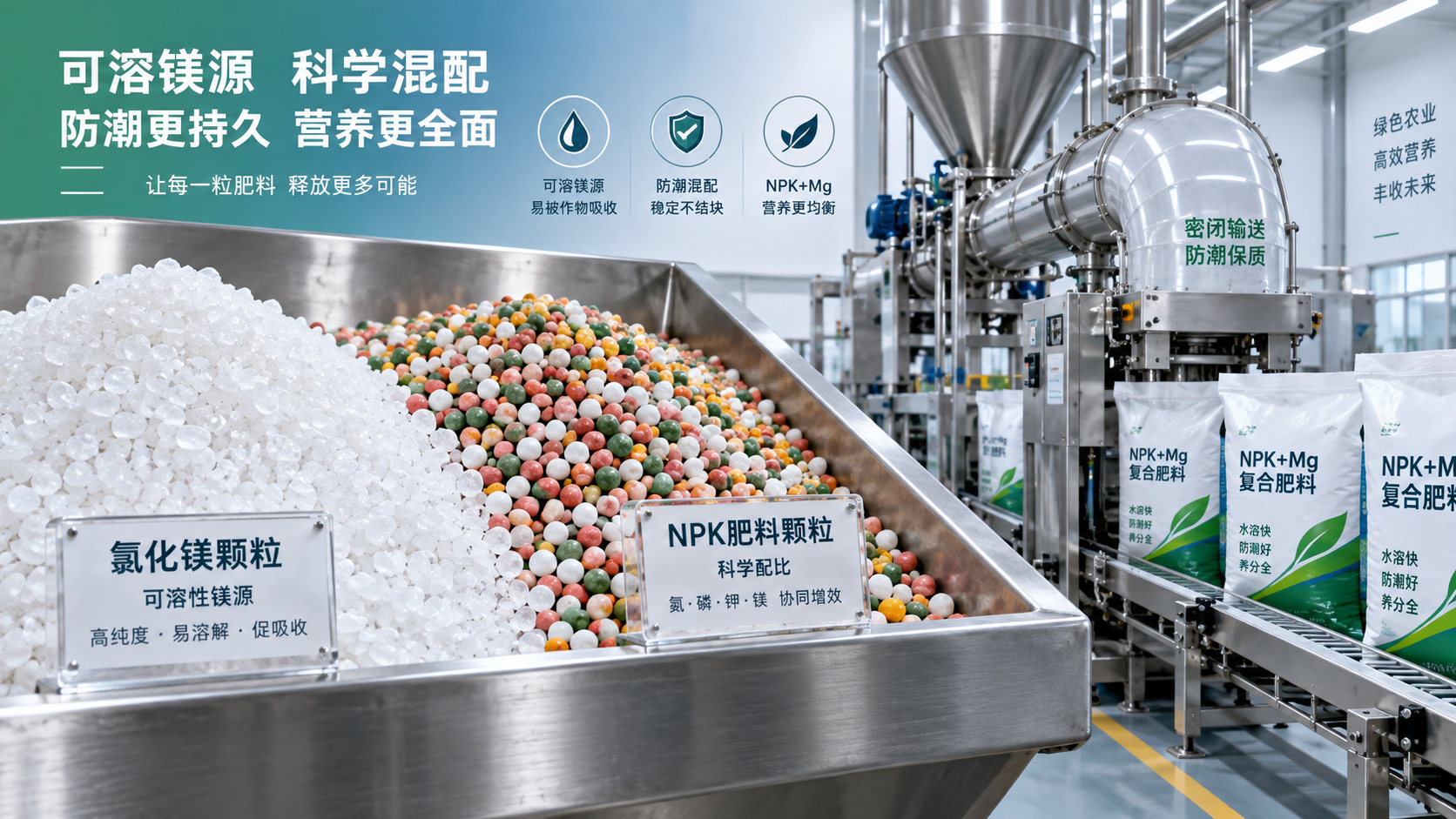
Magnesium chloride can be suitable for fertilizer blending, but it is not a universal magnesium source. Its strongest fit is in formulations where chloride is agronomically acceptable, rapid magnesium availability is needed, and the blend can be protected from moisture uptake. It is a weaker choice for chloride-sensitive crops, saline soils, humid-storage environments, and blends requiring long physical stability without specialized conditioning or packaging.
The central question is therefore not whether magnesium chloride supplies magnesium—it does—but whether its accompanying chloride, physical behavior, and handling requirements match the intended crop, soil, delivery system, and distribution route. A formulation that performs well in a dry bulk blend for a chloride-tolerant field crop may be unsuitable for protected horticulture, high-value fruit production, or regions managing salt accumulation.
What magnesium chloride contributes to a fertilizer blend
Magnesium is a secondary plant nutrient with a direct role in chlorophyll formation, photosynthesis, enzyme activation, and carbohydrate movement within the plant. Deficiency risk is often associated with light, acidic, sandy, heavily leached, or high-potassium soils, although diagnosis should not rely on visual symptoms alone. Interveinal chlorosis on older leaves can indicate magnesium deficiency, but similar symptoms may also arise from other nutrient imbalances or root-zone constraints.
Magnesium chloride is highly water-soluble. This gives it a practical advantage where a readily available magnesium source is desired. In dry fertilizer blends, its solubility can support relatively prompt dissolution after adequate soil moisture is present. In liquid systems, an appropriate grade may also be used as a magnesium ingredient, subject to formulation chemistry and the supplier’s specification.
Its limitation is inseparable from its value: magnesium chloride delivers chloride as well as magnesium. Chloride is itself an essential plant micronutrient, and some crops can benefit from chloride where soil supply is low. Yet the margin between adequate chloride nutrition and excess salt exposure can be narrow in certain production systems. The correct evaluation must consider the full chloride load from all fertilizer ingredients, irrigation water, soil reserves, and, where relevant, recycled water sources.
The comparison that matters: magnesium chloride versus other magnesium sources
Choosing a magnesium input by magnesium content alone is a common formulation error. The anion attached to magnesium changes the agronomic profile of the finished fertilizer, while solubility, handling characteristics, and cost per unit of available magnesium determine whether the source is operationally useful.
Magnesium sulfate is often the more straightforward comparator. Where sulfur is agronomically valuable and chloride must be minimized, sulfate-based magnesium has an evident advantage. This does not mean sulfate is automatically superior. If sulfur is already high, or if chloride-responsive crops and low-salinity soils are involved, magnesium chloride can be a rational source. The formulation decision should be based on the nutrient program as a whole, not on a simple ranking of raw materials.
Magnesium nitrate serves a different purpose. It is generally selected when nitrate nitrogen is desired alongside magnesium, especially in soluble nutrient programs. It should not be treated as a direct substitute for magnesium chloride in every bulk blend because it changes the nitrogen analysis, regulatory classification in some jurisdictions, and storage-management profile of the finished product.
Magnesium oxide and dolomitic materials answer another question entirely: whether the priority is soluble magnesium delivery or longer-term magnesium and pH management. Their lower solubility can be a limitation for immediate nutrient correction but may be useful in appropriate soil-amendment strategies. Replacing a soluble chloride source with an oxide without adjusting application timing can lead to a very different field outcome.
Chloride is the agronomic dividing line
Chloride should neither be treated as an automatic benefit nor dismissed as a contaminant. It is a plant nutrient at low levels, contributes to osmotic regulation and stomatal function, and can be relevant in chloride-deficient conditions. The concern arises when cumulative chloride application raises root-zone salinity or conflicts with the crop’s sensitivity.
Crops vary substantially in their response to chloride. Tobacco, potato, grapevine, many fruit crops, and several greenhouse or high-value horticultural crops are often managed with tighter chloride restrictions. In potatoes, for example, chloride management may be considered not only in relation to yield but also to quality objectives. The appropriate threshold depends on cultivar, soil texture, rainfall or irrigation regime, existing salinity, and the rest of the nutrient plan; no single raw-material rule can replace crop-specific guidance.
Soil and water conditions can be as important as crop type. In coarse-textured soils with effective drainage and sufficient rainfall, soluble chloride may move beyond the active root zone more readily than in poorly drained soils. In arid or semi-arid production areas, under limited leaching, or where irrigation water already contributes significant dissolved salts, chloride accumulation deserves much closer attention. A fertilizer blend can be chemically compliant and still agronomically unsuitable if its salt contribution is not assessed against local conditions.
For this reason, chloride accounting should be performed at the formulation stage. The calculation needs to include potassium chloride, magnesium chloride, calcium chloride if present, micronutrient carriers, and irrigation-water chloride where that information is available. Looking only at the magnesium chloride addition understates the real salt load of the nutrient program.
Physical blending is often the harder problem
A blend can be agronomically well designed yet fail commercially because its particles separate, cake, liquefy, or lose nutrient uniformity in storage. Magnesium chloride is strongly hygroscopic: it attracts moisture from the surrounding air. This characteristic is central to its use in fertilizer blending.
In a conventional bulk-blending operation, hygroscopic material can create several problems. It may soften the blend, promote caking at contact points, reduce flow through hoppers, adhere to conveyors, and increase the risk that fine particles attach unevenly to larger granules. The resulting product may not remain homogeneous through bagging, transport, warehouse storage, and field application. Segregation is particularly relevant when magnesium chloride particles differ sharply in size, density, or shape from the NPK granules with which they are mixed.
The physical grade matters as much as the chemical assay. A product sold as magnesium chloride may be flakes, powder, prills, granules, or a hydrated form with different moisture and handling behavior. Material intended for industrial de-icing, dust control, or other non-fertilizer uses should not be assumed suitable for agricultural blending. The relevant purchase specification should address nutrient analysis, water-insoluble matter, moisture, particle-size distribution, bulk density, heavy-metal limits where applicable, and the product’s intended fertilizer use.
Where magnesium chloride is selected, the blending system should be designed around its moisture sensitivity rather than treating it like a stable granular commodity. This can involve close particle-size matching, short storage periods after blending, moisture-resistant bags, controlled warehouse humidity, and avoidance of exposure during loading and unloading. Coating agents or conditioning technologies may improve flowability in some systems, but they need to be validated for the specific formulation. A coating that works with one NPK base may not prevent caking when another component has higher moisture or finer particle size.
Compatibility depends on the product form, not only on the nutrient list
“Compatible” can mean several different things: chemically stable, physically blendable, acceptable in solution, safe for the intended application equipment, and compliant with labeling requirements. Magnesium chloride may meet one of these tests and fail another.
For dry blends, physical compatibility is normally the immediate concern. Granular magnesium chloride with a narrow and suitable particle-size range may be manageable in a controlled dry-blending line, while a fine or flaky product can be difficult to distribute uniformly. If magnesium chloride is used at a low inclusion rate, the risk of uneven nutrient distribution becomes more significant. A small quantity of fine, hygroscopic material can concentrate in parts of the blend rather than coating all granules evenly.
For liquid fertilizers, the issue shifts to solubility, temperature stability, and interactions with other ions. Magnesium chloride dissolves readily, but the full formulation may still precipitate if it contains phosphate, calcium, or other components that form poorly soluble salts under the selected pH and concentration. Water quality also matters. A successful bench dissolution test is useful but does not by itself establish storage stability across temperature changes or validate behavior in production-scale tanks.
Application method introduces a further distinction. Soil-applied chloride may be manageable in a suitable field situation, while direct contact with sensitive foliage in concentrated foliar applications can pose a different risk. The suitability of magnesium chloride as a soil nutrient source should not be interpreted as a blanket endorsement for every fertigation or foliar use.
Quality control and trade documentation are part of the decision
International fertilizer supply adds a layer of risk that is easy to overlook when the raw material is evaluated only by advertised magnesium content. Chemical identity, hydration state, declared nutrient basis, and impurity limits must be clear in purchase documentation. Magnesium may be declared as elemental Mg or as MgO equivalent, and comparison errors occur when quotations use different bases without conversion.
Sampling and inspection requirements should reflect the product’s tendency to absorb water. A moisture result can change if sampling, sealing, and testing are poorly controlled. Receiving procedures should define how lots are sampled, how retained samples are stored, and what evidence accompanies each shipment, such as a certificate of analysis, safety documentation, and origin or traceability records where needed.
Regulatory acceptance is market-specific. Fertilizer rules can govern permitted nutrient sources, labeling terminology, declared analysis, contaminants, packaging, and registration. Organic production rules may impose separate restrictions on input origin and processing. A material that can be sold as a fertilizer ingredient in one destination may require different documentation, labeling, or registration treatment in another. The importing party should confirm the requirements of the destination market before production and shipment, not after a finished blend is in transit.
Logistics conditions deserve the same scrutiny. Magnesium chloride’s hygroscopicity means that long sea transit, port delays, damaged liners, and humid warehousing can affect product condition. A lower purchase price can be offset by losses from caking, reprocessing, downgraded inventory, or customer complaints about poor spreadability. The practical comparison is therefore delivered, usable magnesium—not merely ex-works cost per tonne.
When magnesium chloride is a sound choice
Magnesium chloride is most defensible when the formulation needs soluble magnesium, chloride fits the crop and soil program, and the supply chain can keep the product dry and physically stable. It can also be relevant where the chloride contribution is deliberately included within a balanced nutrient design rather than accepted inadvertently.
It is generally less suitable where chloride exclusion is an explicit crop-quality requirement, where salinity is already a limiting soil or water factor, or where the blending and distribution system cannot control moisture. In those cases, magnesium sulfate, magnesium nitrate, magnesium oxide, or another magnesium source may provide a better technical fit, even if the quoted raw-material cost is higher.
The most reliable decision sequence starts with the crop and root-zone conditions, then evaluates the complete nutrient and salt balance, followed by blend physical properties, storage route, and destination-market requirements. Magnesium chloride is not simply a low-cost magnesium ingredient or a substitute for magnesium sulfate. It is a specific nutrient carrier whose chloride content and hygroscopic behavior must be treated as core formulation variables.
أرسل استفسارك إلينا اليوم